Why Pierre-Auguste, what big paintings you have!
When one thinks Impressionism, one doesn’t think scale – Monet’s later works notwithstanding. But Renoir liked big. And it was radical. Big was reserved for famous (or rich) people. Renoir painted ordinary people on big canvases. This folks, this is modernism.
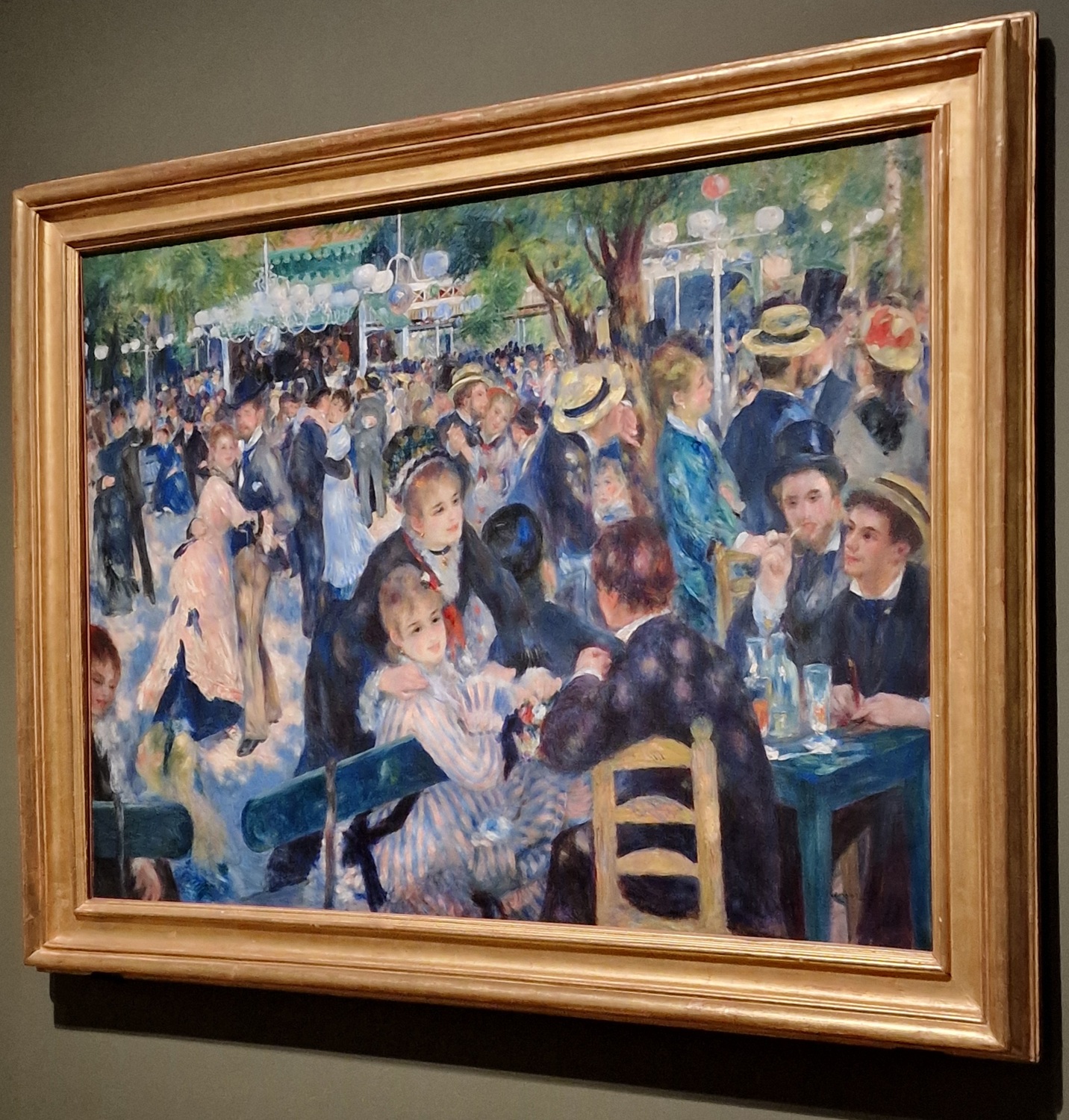
Dance at the Moulin de la Galette
Everyone knows the Renoir debates – is it sentimental or radical, is he just “the one who did colour”, is “happy” (his own word) enough to make something great art? Walking round Renoir & Love, it’s easy to forget about all that and just enjoy the work. And the scale of some of the pieces is part of the appeal.
The much lauded Dance at the Moulin de la Galette (1876) is a tremendous work capturing the energy and joy of ordinary people writ large. The Umbrellas (1881-86) is another large-scale treat if perhaps not as compelling as Caillebotte’s earlier, arguably more famous and definitely more austere, Paris Street; Rainy Day (1877) (umbrella fact: steel-ribbed umbrellas were introduced as late as 1852). The two beautifully hung dancing paintings from 1883 – Dance at Bougival and Dance in the Country – are epic in scale, charming, and loaded with oblique commentary.
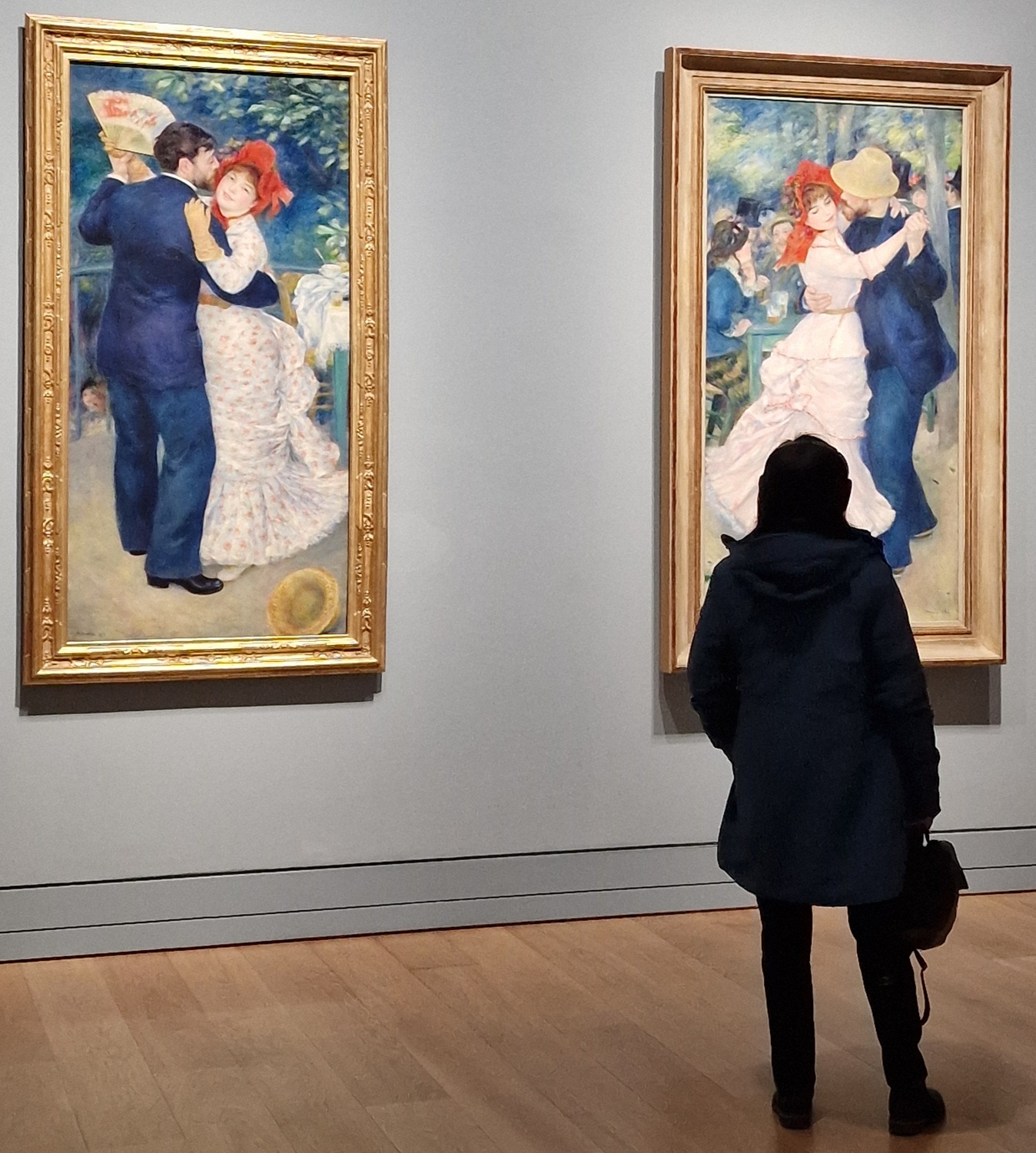
Dance in the Country (left), and Dance at Bougival. Photo ©Jonathan Turton
Renoir loved painting people – and this exhibition focuses heavily on relationships between subjects and between the viewer and the painting. He’s famous for having people (and a dog) stare out from the painting. Sometimes it seems this is to add warmth – an invitation. But it also seems there’s sometimes something else going on. The gaze isn’t always saying “I’d love you to come and join me at this Montmartre dance party” – but rather “What are you looking at?” Not in the sense of starting a pub fight, but really “what” and “who” are you looking at, and what’s really going on here?
Renoir was interested in the role of women in modernising Parisian society, and many of his works contain an ambiguity in the relationships between men and women – and indeed two women in one case – but Renoir never passes judgment. Not on the women anyway. At a time when single women’s morals were widely questioned, it’s the men in Renoir’s paintings who seem to be acting dubiously. What are you looking at – and why?
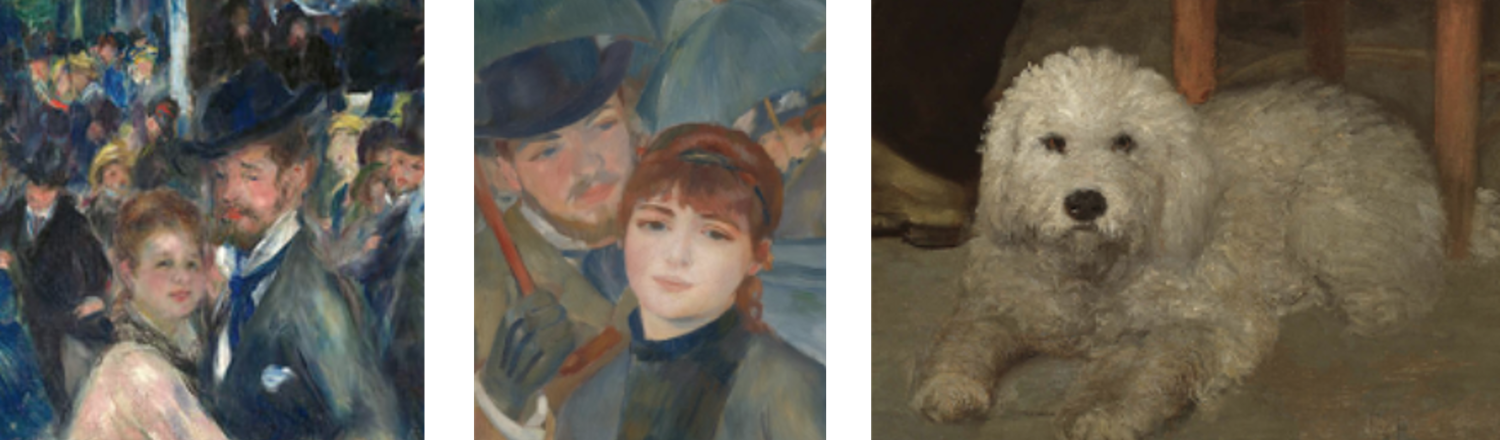
Details from Dance at the Moulin de la Galette, The Umbrellas, Mother Antony’s Tavern. All via the National Gallery website
Another joy is that these paintings still look amazing some 150 years after they were painted. Credit to the National Gallery curators for the selection of paintings, the accompanying text, the hang and the lighting. If ever you wanted paintings to be well lit, it’s Impressionist works of light and colour and these are positively radiant. The posters and prints in the shop are so flat and underwhelming in contrast that it actively put me off buying them.
Yes, there’s sentimentality, but this targeted exhibition does a good job of repositioning Renoir back in the fold of Top Impressionists – for his ideas as much as for his brushstrokes.
Took me by surprise 8/10